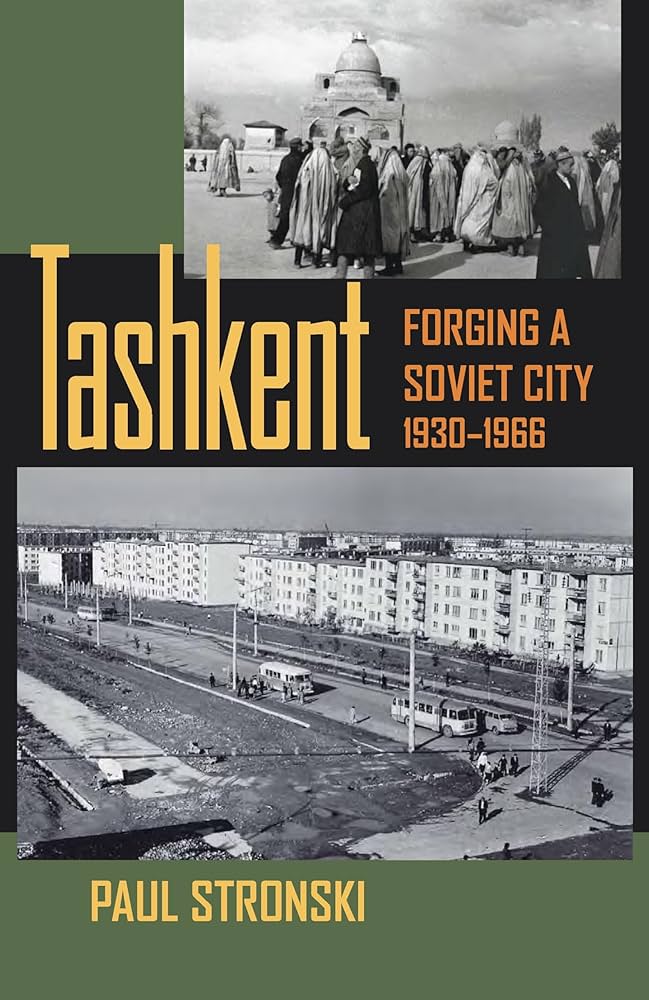
Tashkent Forging a Soviet City, 1930-1966
Tashkent Forging a Soviet City, 1930-1966
Couldn't load pickup availability
Important Details
Our delivery time will be between 48hs to 72hs, except for remote areas that might take longer.
Contact us to establish the exact delivery time frame expectation.
Next day delivery from Monday to Saturday will be possible (as long as your order is placed the day before 5pm).
We do not collect or deliver on Sundays.
Our books are both: Pre-loved and new, we do not segregate them.
To offer a more affordable experience, we have created a universal price range
Our pre-loved books' condition is generally immaculate.
* Preloved books might include slight paper colour variations, spine creases, small writings or highlights, and generally minor flaws that do not hinder the reading experience.
* Book covers and formats may differ from the copy you receive; however, all books are original editions with complete content. We always try our best to provide the correct cover image.
* If you want to be sure about a specific book edition or translation, contact us before you place your order.
Paul Stronski tells the fascinating story of Tashkent, an ethnically diverse, primarily Muslim city that became the prototype for the Soviet-era reimagining of urban centers in Central Asia. Based on extensive research in Russian and Uzbek archives, Stronski shows us how Soviet officials, planners, and architects strived to integrate local ethnic traditions and socialist ideology into a newly constructed urban space and propaganda showcase. The Soviets planned to transform Tashkent from a “feudal city” of the tsarist era into a “flourishing garden,” replete with fountains, a lakeside resort, modern roadways, schools, hospitals, apartment buildings, and of course, factories. The city was intended to be a shining example to the world of the successful assimilation of a distinctly non-Russian city and its citizens through the catalyst of socialism. As Stronski reveals, the physical building of this Soviet city was not an end in itself, but rather a means to change the people and their society. Stronski analyzes how the local population of Tashkent reacted to, resisted, and eventually acquiesced to the city’s socialist transformation. He records their experiences of the Great Terror, World War II, Stalin’s death, and the developments of the Krushchev and Brezhnev eras up until the earthquake of 1966, which leveled large parts of the city. Stronski finds that the Soviets established a legitimacy that transformed Tashkent and its people into one of the more stalwart supporters of the regime through years of political and cultural changes and finally during the upheavals of glasnost.
Dimensions: 152 x 229
Author: Paul Stronski
ISBN: 9780822961130
Format: Paperback
Pages: 350
Delivery: Standard delivery takes 48–72 working hours. Remote areas may require additional time. Next-day delivery is available Monday to Saturday for orders placed before 5:00 PM on the previous day, subject to availability.
Tracking: Once your order is dispatched, you will receive a tracking number by email.
Track your shipment through First Flight.
Shipping: For delivery rates, free delivery eligibility, and serviceable areas,
visit our Shipping Information page.
Returns & Refunds: For information about returns, exchanges, and refunds,
please refer to our Refund & Return Policy.
All prices and charges include 5% VAT. For any assistance, please contact our customer support team. We value your feedback!