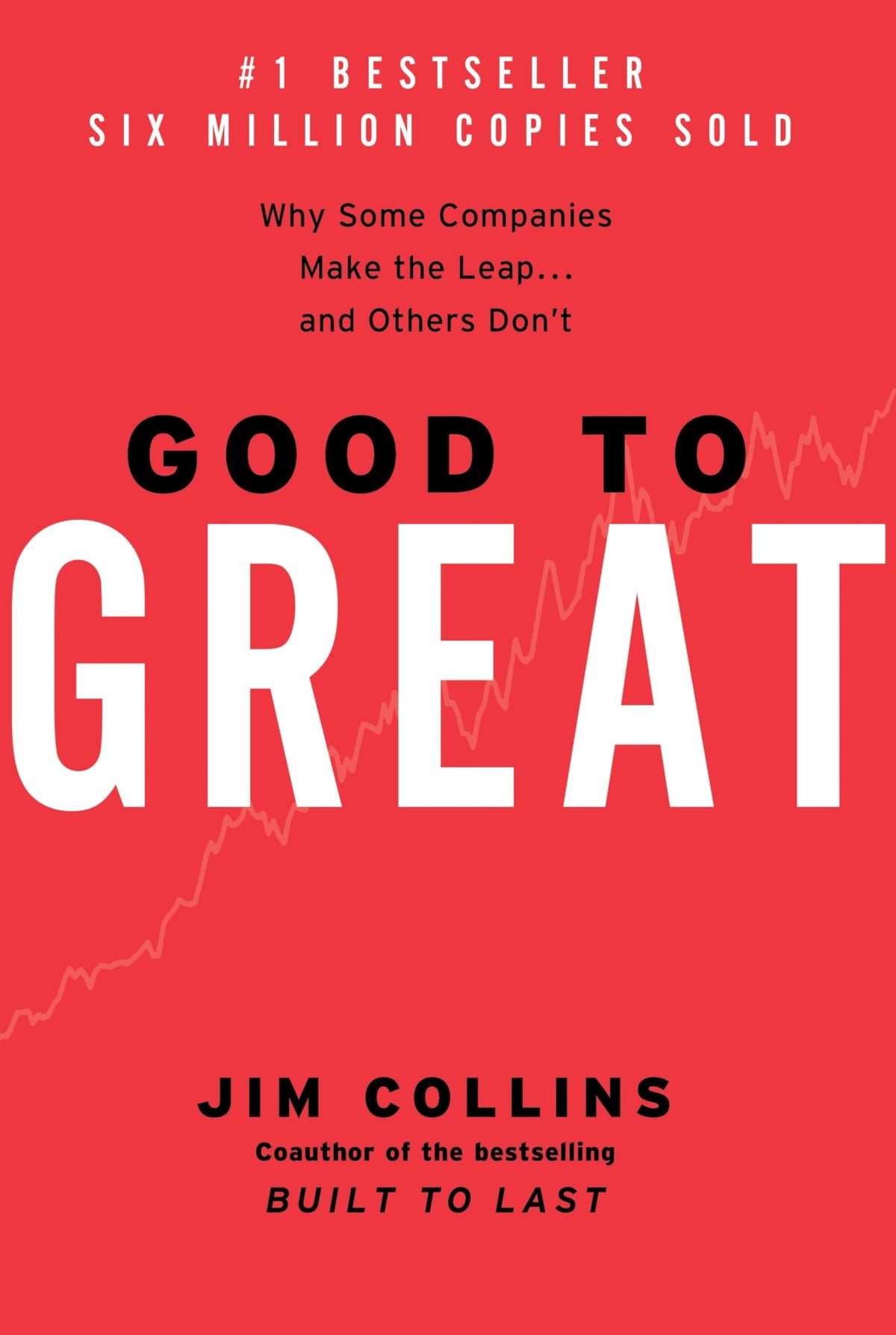
Good to Great Why Some Companies Make the Leap...And Others Don't
Good to Great Why Some Companies Make the Leap...And Others Don't
Couldn't load pickup availability
Important Details
Our delivery time will be between 48hs to 72hs, except for remote areas that might take longer.
Contact us to establish the exact delivery time frame expectation.
Next day delivery from Monday to Saturday will be possible (as long as your order is placed the day before 5pm).
We do not collect or deliver on Sundays.
Our books are both: Pre-loved and new, we do not segregate them.
To offer a more affordable experience, we have created a universal price range
Our pre-loved books' condition is generally immaculate.
* Preloved books might include slight paper colour variations, spine creases, small writings or highlights, and generally minor flaws that do not hinder the reading experience.
* Book covers and formats may differ from the copy you receive; however, all books are original editions with complete content. We always try our best to provide the correct cover image.
* If you want to be sure about a specific book edition or translation, contact us before you place your order.
The Challenge Built to Last, the defining management study of the nineties, showed how great companies triumph over time and how long-term sustained performance can be engineered into the DNA of an enterprise from the verybeginning. But what about the company that is not born with great DNA? How can good companies, mediocre companies, even bad companies achieve enduring greatness? The Study For years, this question preyed on the mind of Jim Collins. Are there companies that defy gravity and convert long-term mediocrity or worse into long-term superiority? And if so, what are the universal distinguishing characteristics that cause a company to go from good to great? The Standards Using tough benchmarks, Collins and his research team identified a set of elite companies that made the leap to great results and sustained those results for at least fifteen years. How great? After the leap, the good-to-great companies generated cumulative stock returns that beat the general stock market by an average of seven times in fifteen years, better than twice the results delivered by a composite index of the world's greatest companies, including Coca-Cola, Intel, General Electric, and Merck.The Comparisons The research team contrasted the good-to-great companies with a carefully selected set of comparison companies that failed to make the leap from good to great. What was different? Why did one set of companies become truly great performers while the other set remained only good? Over five years, the team analyzed the histories of all twenty-eight companies in the study. After sifting through mountains of data and thousands of pages of interviews, Collins and his crew discovered the key determinants of greatness -- why some companies make the leap and others don't. The Findings The findings of the Good to Great study will surprise many readers and shed light on virtually every area of management strategy and practice. The findings include:Level 5 Leaders: The research team was shocked to discover the type of leadership required to achieve greatness. The Hedgehog Concept (Simplicity within the Three Circles): To go from good to great requires transcending the curse of competence. A Culture of Discipline: When you combine a culture of discipline with an ethic of entrepreneurship, you get the magical alchemy of great results. Technology Accelerators: Good-to-great companies think differently about the role of technology. The Flywheel and the Doom Loop: Those who launch radical change programs and wrenching restructurings will almost certainly fail to make the leap.“Some of the key concepts discerned in the study,” comments Jim Collins, "fly in the face of our modern business culture and will, quite frankly, upset some people.” Perhaps, but who can afford to ignore these findings?
Dimensions: 155 x 235 x 26
Author: James C. Collins
ISBN: 9780066620992
Format: Hardcover
Pages: 320
Delivery: Standard delivery takes 48–72 working hours. Remote areas may require additional time. Next-day delivery is available Monday to Saturday for orders placed before 5:00 PM on the previous day, subject to availability.
Tracking: Once your order is dispatched, you will receive a tracking number by email.
Track your shipment through First Flight.
Shipping: For delivery rates, free delivery eligibility, and serviceable areas,
visit our Shipping Information page.
Returns & Refunds: For information about returns, exchanges, and refunds,
please refer to our Refund & Return Policy.
All prices and charges include 5% VAT. For any assistance, please contact our customer support team. We value your feedback!