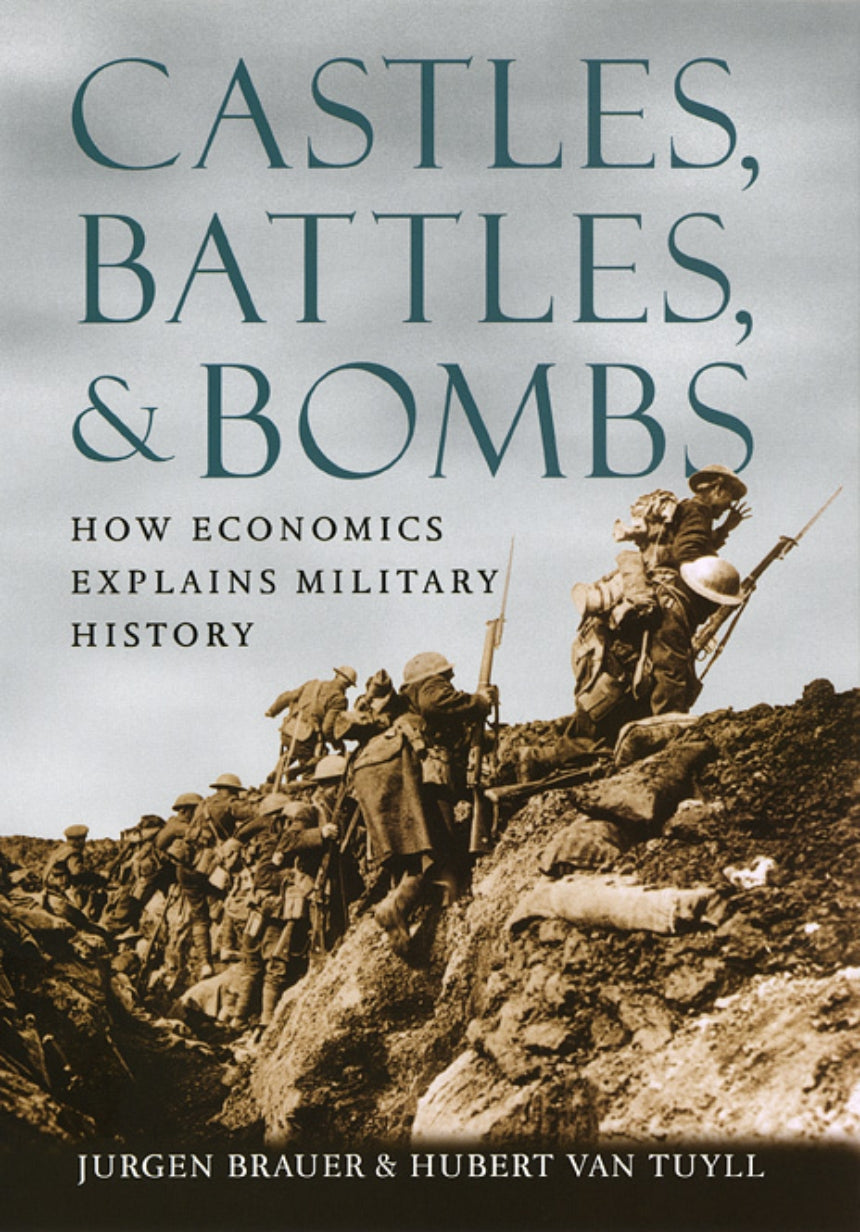
Castles, Battles, and Bombs How Economics Explains Military History
Castles, Battles, and Bombs How Economics Explains Military History
Couldn't load pickup availability
Important Details
Our delivery time will be between 48hs to 72hs, except for remote areas that might take longer.
Contact us to establish the exact delivery time frame expectation.
Next day delivery from Monday to Saturday will be possible (as long as your order is placed the day before 5pm).
We do not collect or deliver on Sundays.
Our books are both: Pre-loved and new, we do not segregate them.
To offer a more affordable experience, we have created a universal price range
Our pre-loved books' condition is generally immaculate.
* Preloved books might include slight paper colour variations, spine creases, small writings or highlights, and generally minor flaws that do not hinder the reading experience.
* Book covers and formats may differ from the copy you receive; however, all books are original editions with complete content. We always try our best to provide the correct cover image.
* If you want to be sure about a specific book edition or translation, contact us before you place your order.
Castles, Battles, and Bombs reconsiders key episodes of military history from the point of view of economics—with dramatically insightful results. For example, when looked at as a question of sheer cost, the building of castles in the High Middle Ages seems almost inevitable: though stunningly expensive, a strong castle was far cheaper to maintain than a standing army. The authors also reexamine the strategic bombing of Germany in World War II and provide new insights into France’s decision to develop nuclear weapons. Drawing on these examples and more, Brauer and Van Tuyll suggest lessons for today’s military, from counterterrorist strategy and military manpower planning to the use of private military companies in Afghanistan and Iraq. "In bringing economics into assessments of military history, [the authors] also bring illumination. . . . [The authors] turn their interdisciplinary lens on the mercenary arrangements of Renaissance Italy; the wars of Marlborough, Frederick the Great, and Napoleon; Grant's campaigns in the Civil War; and the strategic bombings of World War II. The results are invariably stimulating."—Martin Walker, Wilson Quarterly "This study is serious, creative, important. As an economist I am happy to see economics so professionally applied to illuminate major decisions in the history of warfare."—Thomas C. Schelling, Winner of the 2005 Nobel Prize in Economics
Dimensions: 152 x 229
Author: Jurgen Brauer
ISBN: 9780226071633
Format: Hardcover
Pages: 403
Delivery: Standard delivery takes 48–72 working hours. Remote areas may require additional time. Next-day delivery is available Monday to Saturday for orders placed before 5:00 PM on the previous day, subject to availability.
Tracking: Once your order is dispatched, you will receive a tracking number by email.
Track your shipment through First Flight.
Shipping: For delivery rates, free delivery eligibility, and serviceable areas,
visit our Shipping Information page.
Returns & Refunds: For information about returns, exchanges, and refunds,
please refer to our Refund & Return Policy.
All prices and charges include 5% VAT. For any assistance, please contact our customer support team. We value your feedback!