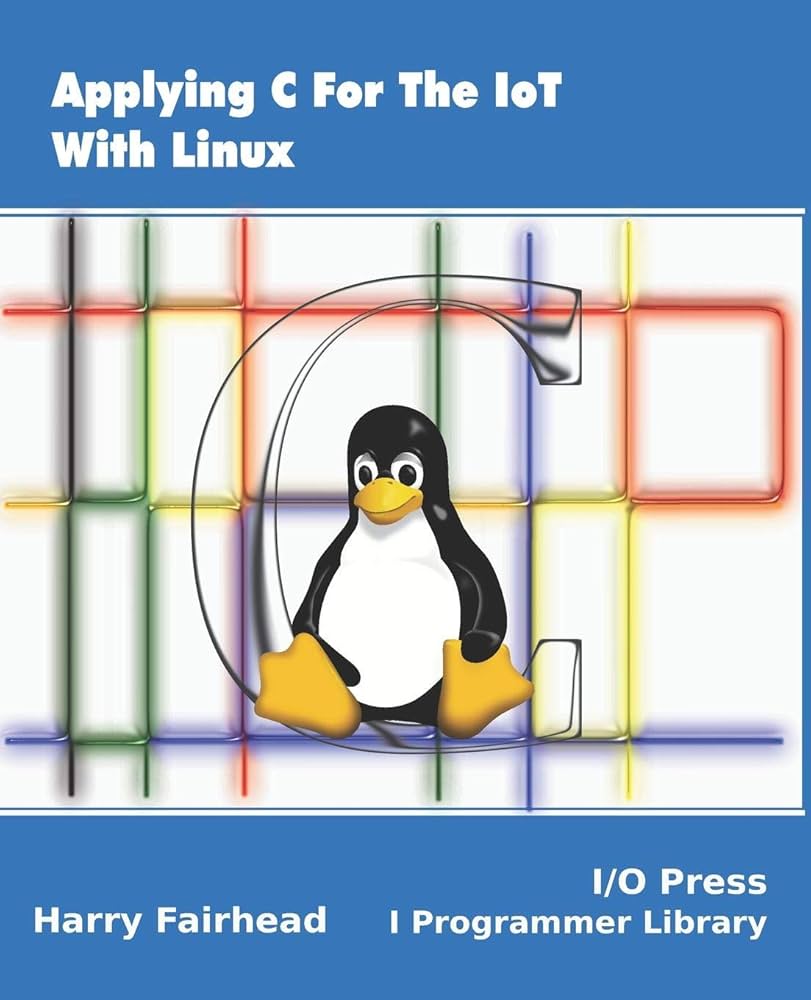
Applying C for the IoT with Linux
Applying C for the IoT with Linux
Couldn't load pickup availability
Important Details
Our delivery time will be between 48hs to 72hs, except for remote areas that might take longer.
Contact us to establish the exact delivery time frame expectation.
Next day delivery from Monday to Saturday will be possible (as long as your order is placed the day before 5pm).
We do not collect or deliver on Sundays.
Our books are both: Pre-loved and new, we do not segregate them.
To offer a more affordable experience, we have created a universal price range
Our pre-loved books' condition is generally immaculate.
* Preloved books might include slight paper colour variations, spine creases, small writings or highlights, and generally minor flaws that do not hinder the reading experience.
* Book covers and formats may differ from the copy you receive; however, all books are original editions with complete content. We always try our best to provide the correct cover image.
* If you want to be sure about a specific book edition or translation, contact us before you place your order.
Applying C is the book you need if you are programming for Single Board Computers (SBCs) that run Linux, or if you do any coding in C that interacts with the hardware. As there isn't a good name for this body of knowledge, it isn't easy to find a single source for it. This book gathers together all of these low-level, hardware-oriented and often hardware-specific ideas. As such it is a moderately advanced book. This is not to say that it is difficult, but it does presuppose that you already know how to program in C and that you know the basic idioms of C. Starting off from the very simple task of making a program run automatically, we look at how your program works with user-mode Linux. If you are working with hardware, arithmetic cannot be ignored and separate chapters are devoted to integer, fixed-point and floating-point arithmetic. Equally, to handle I/O you need to have a good grasp of files and the pseudo file system. The dev/mem file coupled with memory-mapped files makes it possible to work with raw memory without leaving user mode. Sockets are general-purpose way of communicating over networks and similar infrastructure and here the focus is on sending data over the internet and for this we build a web client and a server. Next we consider graphics, which you might find unusual in a book on small systems, but today even small systems have GPUs and graphics comes as standard. It is common to think of adding low-cost output devices such as 7-segment displays to IoT devices, but with low cost HDMI/DVI displays available it becomes cost effective to simply use the built-in graphics hardware. After this we turn to the idea of multi-tasking using Pthreads. As well as looking at threads, we consider locking, using mutex and condition variables, and scheduling. Although interrupts don't exist in user-mode Linux, we can get very close using poll and threading. Now that multiple cores are a feature of even low-cost SBC, in later chapters we cover managing cores, look at C11's atomics and introduce its memory models and barriers. Finally we take a short look at how to mix assembler with C. Harry Fairhead has a hardware background and, having worked with microprocessors and electronics in general, for many years, he is an enthusiastic proponent of the IoT. He is the author of Fundamental C: Getting Closer To The Machine and his other recent titles include Raspberry Pi IoT in C and Micro: bit IoT in C.
Dimensions: 191 x 235 x 19
Author: Harry Fairhead
ISBN: 9781871962611
Format: Paperback
Pages: 334
Delivery: Standard delivery takes 48–72 working hours. Remote areas may require additional time. Next-day delivery is available Monday to Saturday for orders placed before 5:00 PM on the previous day, subject to availability.
Tracking: Once your order is dispatched, you will receive a tracking number by email.
Track your shipment through First Flight.
Shipping: For delivery rates, free delivery eligibility, and serviceable areas,
visit our Shipping Information page.
Returns & Refunds: For information about returns, exchanges, and refunds,
please refer to our Refund & Return Policy.
All prices and charges include 5% VAT. For any assistance, please contact our customer support team. We value your feedback!